
Custom Plush Sample Approval Checklist: What to Check Before Bulk Production

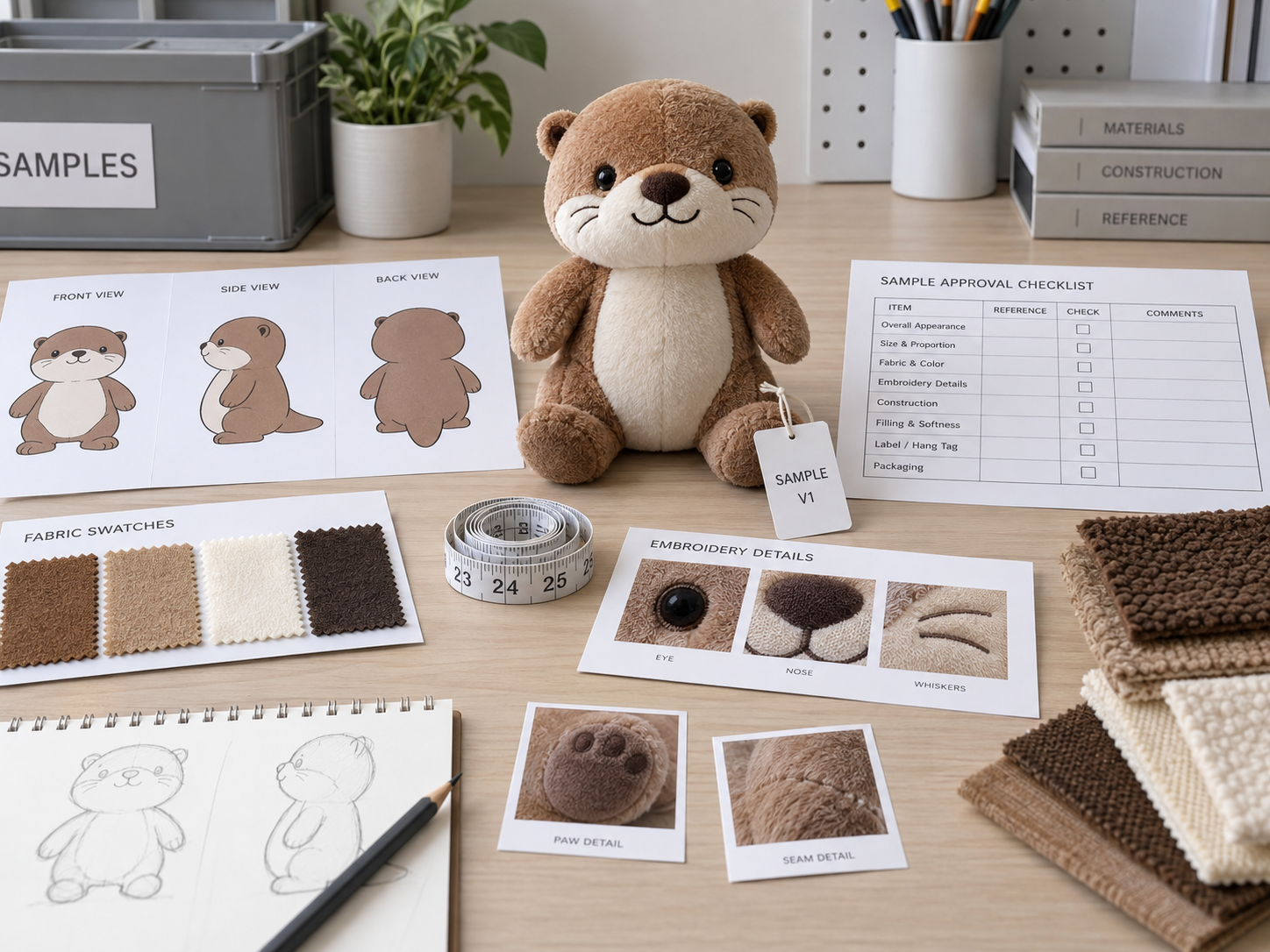
Approval of a custom plush toy design does not simply mean “it looks good.” Before the design goes into mass production, the following should be confirmed: the specific sample version; the character’s visual design; the commercially finalized dimensions, materials, construction, and workmanship; any labeling or packaging details; and whether all revision requests have been addressed or if there are any explicitly unresolved issues.
The safest workflow is clear, version-controlled, and traceable. It should answer the following three questions:
What has been approved?
What still needs to be revised or confirmed separately?
Which samples and documents will be used as references for the next phase?
This checklist is designed to help brand teams, staff, licensing teams, importers, promotional product buyers, and creators determine whether a plush toy prototype is ready to move the project forward.
The True Significance of Sample Approval
Prototyping is the process of transforming a two-dimensional concept into a physical prototype. This transformation is critical because plush toys are three-dimensional, soft, and compressible, and are influenced by key factors such as fabric, filling material, stitching placement, shaping, and pose.
Therefore, sample approval should be viewed as a go-ahead decision for a specific product version.
A valid approval record should link the decision to the following:
The specific sample or reference sample.
Current artwork and specification documents.
The latest revision notes.
Material and color reference information used for the sample.
Any labels, accessories, or packaging included in the scope of approval.
A list of all outstanding items (if any).
A common issue arising from differing interpretations between the two parties is as follows: one party believes that a sample must be “as-is” to be approved, while the other believes that only the overall appearance needs to be approved.
Approval of a sample does not imply automatic approval of product safety testing, mass production quality, shipment inspection, commercial terms, or all packaging decisions. These matters should be managed during their respective project phases.
- If applicable, please provide the latest front, side, and back views.
- Target dimensions and any key measurement points.
- Existing configuration or color references.
- Logo, size, printing, labeling, and accessory files.
- Previous revision notes.
- Photos of the current sample taken from multiple angles.
- The product’s appearance, texture, padding, dimensions, color, and fit are critical.
- If packaging is part of this iteration process, please provide packaging documents or packaging samples.
- A list of known unresolved issues.
1. Start with Imitation, Poses, and Overall Proportions
Begin with the overall shape, then examine the finer details.
Observe the plush toy from the front, along the main axis, from the back, and from a three-quarter side view. Compare the results with the approved character design direction or product brief.
Check:
Head-to-body ratio.
The width and thickness of the main body.
The length of the arms and legs.
Ears, horns, tails, wings, or antennae.
Sitting, standing, hanging, or lying-down poses.
Balance and proportion, as reflected in the item’s sense of scale.
Sketching the shape.
Rear shape and color blocks.
Focus on the relationships between the various components rather than on individual measurements.
A plush toy may look well-proportioned from the front, but it might appear thin from the side or disproportionate from the back—especially when judged solely against a promotional photo.
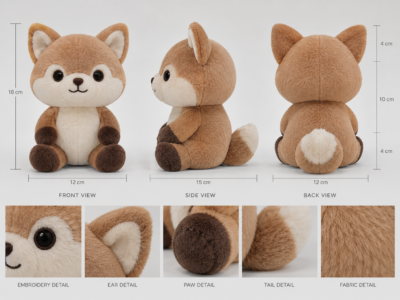
2. Check the face and other key identifying details
For cartoon character merchandise, the face is often more recognizable than any other part of the body.
-The height and spacing of the eyes
-The angle and position of the eyes.
-The position and proportions of the nose.
-The shape and expression of the mouth.
-Where relevant, measure the angle of the eyebrows or eyelids.
-Eyebrow shape, freckles, facial hair, scars, or markings.
-The proportion of the voice to the head.
-The location of logos or original markings.
-Character-specific color blocks.
-Significant clothing or accessories.
If the design includes patterns, prints, or appliqués, check their placement and visual impact on the selected garment. Patterns that appear clear on a flat screen may look different on velvety fabrics or curved padding.
3. Verify dimensions using the agreed-upon measurement points
Don’t judge the size of a plush toy based solely on how it “feels” in your fingers.
Use the measurement methods specified in the project instructions. Note which dimensions are important and how to measure them.
Depending on the design, useful checkpoints may include:
Overall height when standing or sitting.
Body width.
Head width.
Thickness.
Ear or tail length.
Limb length.
Accessory dimensions.
Factors affecting packaging dimensions.
4. Verify Fabric, Color, Pile, and Texture
When the fabric’s texture, pile, softness, sheen, elasticity, or the feel of the filling is critical to the product, be sure to examine the actual material swatches.
Product type or approved material references.
Surface texture.
Pile length and direction.
Color presentation under consistent, neutral lighting conditions.
Contrast between adjacent colors.
Embroidery thread or printed pigments on the fabric.
Stretch or drape where the shape changes.
Feel.
Whether the selected material meets the expected character details.
If the project uses a specified color chart, color swatch, or approved sample, be sure to compare it against that reference. Never assume that colors on mobile phone images, monitors, fabric swatches, embroidery threads, printed packaging, and finished plush toys will be exactly the same.
Refer to Pantone color numbers rather than merely descriptive phrases such as “dark blue.”
6. Inspect Sewing, Seam Placement, and Visible Finish
The approval sample should be reviewed as an assembled product, not only as a character sculpture.
Look for:
- Twisted or unintentionally visible seams.
- Puckering around curves or embroidery.
- Gaps at seam junctions.
- Loose threads.
- Uneven edge finishing.
- Distortion where small panels meet.
- Misaligned left and right components.
- Fabric pile trapped in seams where it creates a visible line.
- Closure areas that look different from the intended finish.
- Construction details that visibly change the character shape.
Do not turn the buyer review into an improvised laboratory test. If a project requires formal strength, attachment, chemical, flammability, or other safety evaluation, that should be handled under the applicable testing and compliance plan.
The sample review still has an important role: visible construction issues should be caught before a buyer signs off on the physical reference.
7. Verify Embroidery, Printing, Appliqué, Accessories, and Clothing
Decoration methods can look correct in the artwork and still need adjustment on a three-dimensional plush.
For embroidery, printing, appliqué, patches, clothing, or accessories, review:
- Position.
- Scale.
- Rotation.
- Shape.
- Edge quality.
- Legibility of small elements.
- Interaction with seams and pile direction.
- Whether left/right placement is intentional.
- Whether an accessory changes the posture or balance.
- Whether clothing sits in the intended position.
- Whether removable versus permanently attached parts match the brief.
If a logo or licensed marking is important, compare the physical sample to the authorized reference file rather than relying on memory.
Any change that affects product safety or regulatory treatment should be routed to the appropriate technical or compliance review instead of being approved only as a styling decision.
8. Check Labels and Packaging Only Within the Defined Approval Scope
Packaging creates frequent approval confusion because it may develop on a different timeline from the plush itself.
If labels or packaging are part of the current sample approval, review them. If they are not, say so explicitly.
Possible checkpoints include:
- Sewn-in label placement and orientation.
- Hangtag attachment point.
- Barcode or SKU label location.
- Packaging fit.
- Visibility of the product through the packaging.
- Compression or deformation caused by packaging.
- Accessory position after packing.
- Whether the product presents correctly when removed from the package.
- Packout instructions that materially affect presentation.
If packaging is still being developed, a plush sample can still be approved with packaging listed as a separate open workstream—provided everyone understands that packaging has not been approved.
Avoid language such as “final sample approved” when major elements included in the release scope are still unresolved.
9. Close Revision Comments One by One
A sample is not ready simply because the latest version is better than the previous one.
Take the prior revision list and close each comment deliberately.
For every item, assign one status:
- Accepted — the current sample meets the agreed direction.
- Revise — a change is still required.
- Open — a decision is pending and has not been approved.
- Not applicable — the item was removed from scope.
This is more reliable than sending a new email containing only the latest three comments while older comments disappear in the message history.
When possible, identify issues by location and reference image.
Weak:
“Face still looks wrong.”
Stronger:
“Raise the left and right eye placement together; keep the current eye size. See marked photo A3.”
Weak:
“Tail is too big.”
Stronger:
“Reduce tail length while keeping the current attachment position; compare with the back-view artwork.”
The goal is not to write longer comments. It is to remove ambiguity.
10. Lock the Version You Are Approving
The final approval should point to a specific reference.
A practical record can include:
- Sample version or ID.
- Date reviewed.
- Artwork/specification version.
- Material or color reference.
- Photo set or file folder used in the review.
- List of accepted revision items.
- List of open items.
- Name or role of the authorized approver.
- Clear release status.
Avoid a message such as “approved, thanks” when several versions are circulating.
A better approval statement is specific:
“Sample V3 is approved as the visual and construction reference for the plush body based on the attached artwork/specification set dated [date]. Packaging remains open and is not included in this approval.”
The wording should match the real project. The key idea is to define both what the approval includes and what it does not include.
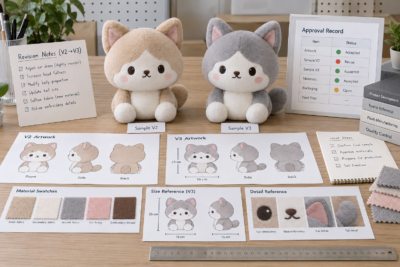
Use a Release / Revise / Hold Decision
At the end of the review, choose one of three outcomes.
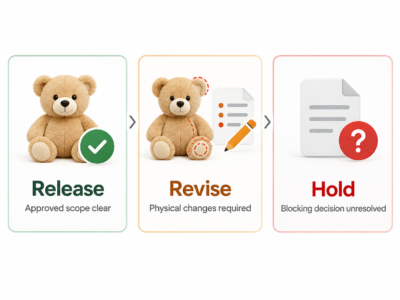
Release
Use Release when the sample and documentation are sufficiently aligned for the next production stage and no unresolved item changes the approved product scope.
Typical conditions:
- Identity-critical details are accepted.
- Overall shape and proportions are accepted.
- Agreed dimensions have been reviewed.
- Material and decoration direction is accepted.
- Construction and visible finish are accepted.
- Included labels/packaging are accepted or clearly excluded from this release.
- Previous revision comments are closed or documented as non-blocking.
- The approved version is clearly identified.
Revise
Use Revise when the direction is correct but specific physical changes are still required before approval.
Examples:
- Facial placement needs adjustment.
- Body volume needs correction.
- An embroidery element is misplaced.
- A material or color reference is wrong.
- An accessory shape or position needs revision.
- Packaging fit fails and packaging is part of the approval scope.
A Revise decision should produce a consolidated change list for the next sample version.
Hold
Use Hold when the team cannot responsibly approve the sample because the reference itself is unclear or a blocking project decision is unresolved.
Examples:
- Different stakeholders are using conflicting artwork versions.
- A major size requirement has not been decided.
- Rights or authorization for branded/IP assets are unresolved.
- The target market or age context changes the technical review and is still unknown.
- A required label, component, or packaging constraint is missing from the brief.
- The team is trying to approve from photos when physical feel or fit is a critical part of the decision.
Hold does not mean the supplier failed. It means the project is not ready for a clean release decision.
Custom Plush Sample Approval Record Template
A simple approval table can keep the decision traceable:
| Review Area | Reference | Status | Comment |
|---|---|---|---|
| Overall shape | Artwork front/side/back | Accepted | Current silhouette approved |
| Face | Marked artwork sheet | Revise | Raise both eyes; keep current size |
| Fabric | Swatch B | Accepted | Use current short-pile material direction |
| Stuffing | Physical Sample V3 | Accepted | Current seated posture approved |
| Label | Label file v2 | Open | Legal copy still under buyer review |
| Packaging | Box dieline | Not in scope | Separate packaging approval required |
After revisions are complete, update the record rather than creating a second, disconnected list.
What Should Not Be Approved From Photos Alone?
Photos are useful for remote communication, but they have limits.
If the characteristic affects touch, physical scale, three-dimensional volume, or material behavior, a buyer may need the physical sample or an agreed physical reference.
Examples include:
- Hand feel.
- Stuffing firmness.
- Actual scale.
- Side-profile volume.
- Fabric pile and sheen.
- How a removable garment fits.
- How an accessory changes balance.
- How the plush fits a box, insert, or display if physical fit is critical.
- Subtle color judgments where screen display is not an adequate reference.
Photos can support approval by documenting angles, details, and revision locations. They should not automatically replace physical review for characteristics that a photograph cannot reliably convey.
Sample Approval Is Not the Same as Compliance, Bulk QC, or Commercial Approval
A strong approval process keeps different decisions separate.
Sample approval answers:
“Is this defined physical product version acceptable as the reference for the next stage?”
Compliance and testing answer:
“What requirements apply to this product and market, and has the required evaluation or documentation been completed?”
Bulk quality control answers:
“Does production remain within the agreed project specifications and quality plan?”
Commercial approval answers:
“Are price, quantity, payment, delivery, and other order terms agreed?”
If you are planning a custom plush toy project and would like to submit design drafts, sample specifications, or project requirements for review, please contact MSXTOYS:
Contact MSXTOYS to discuss your custom plush toy project.
One thought on “Custom Plush Sample Approval Checklist: What to Check Before Bulk Production”