
Custom Plush Sample Approval Checklist: What to Check Before Bulk Production

填写:
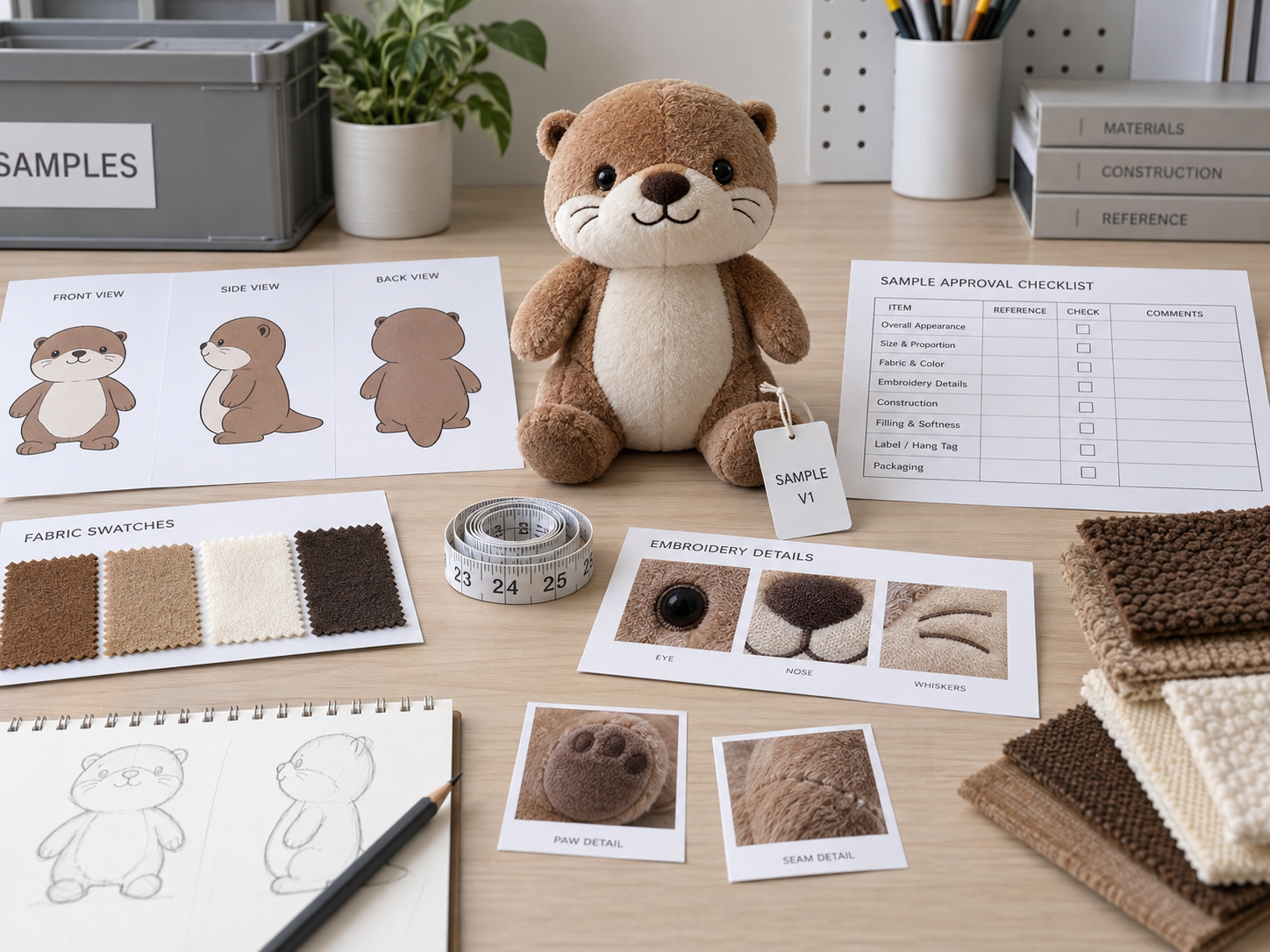
批准好的定制毛绒玩具并不意味着“外观”。在设计稿投入批量生产之前,应对应确认具体的样品版本、定义角色的视觉、商业定型的尺寸和材料、结构和做工、中间范围内的任何标签或包装细节,以及所有修改意见是否已关闭或明确未解决的事项。
最安全的流程图是明确、版本明确且具有可查的。它应该回答以下三个问题:
- 哪些内容获得批准?
- 还有哪些内容需要修改或单独确认?
- 下一阶段将使用哪些样品样品和文件作为参考?
本清单旨在帮助品牌团队、员工、授权角色团队、进口商、促销产品买家和创作者决定毛绒玩具原型是否准备好推进项目。
样品批准的真正意义
原型制作平面概念转化为原型的过程。转变至关重要,因为毛绒玩具是三维的、柔软的、可压缩的,并且会受到面料、填充物、缝线位置、青少年、造型和姿势等重要因素的影响。
因此,样品批准应被视为针对特定产品版本的发布决定,而不是整个项目已经完成的一般性声明。
一份有效的体育记录可以将决策与以下内容联系起来:
- 具体样品或参考样品。
- 当前的艺术作品和规格文件。
- 最新修订意见。
- 该样品所使用的材料和颜色参考信息。
- 批准范围内的任何标签、配件或包装。
- 列出所有尚未完成的项目(如有)。
区别保护双方工作站一个常见问题的影响如下:一方认为样品“按”才能获得批准,而另一方则认为只有整体外观才能获得批准。
批准样品并不意味着自动批准产品安全测试、批量生产质量、发货检验、商业条款或所有包装决策。这些事项应在各自的项目阶段进行管理。
开始之前,请先准备好体育包
不要凭记忆复习例句。
在内部审查开始之前,将所有现有的参考文献集中放在一处。一个简单的数据审查包可能包括:
- 如果,请提供最新的正面、侧面和背面头像。
- 目标尺寸和任何关键测量点。
- 现有配置或颜色参考资料。
- 标志、年龄、印刷、标签和配件文件。
- 之前的修订意见。
- 从多个角度拍摄的当前样品照片。
- 产品外观的手感、填充物、尺寸、颜色或合体度非常重要。
- 如果包装是本次迭代流程的一部分,请提供包装文件或包装样品。
- 已知未解问题列表。
这样做的目的并不是为了制造不必要的工作,而是为了确保每个人都针对相同的目标和相同的版本。
如果涉及多个利益相关者,请为评审资料包指定日期或版本名称。避免将先前样本的意见与当前样本的意见混淆。
1.从模仿、姿势和整体比例入手
先从大的形状入手,再去检查细小的细节。
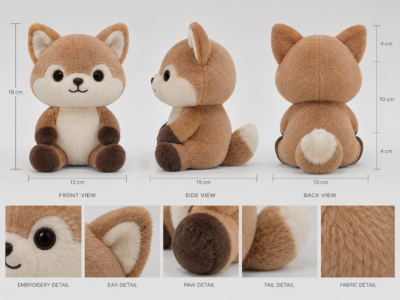
从正面、主轴、背面和四分之三侧面观察毛绒玩具。将效果与已批准的角色设计方向或产品简介进行比较。
查看:
- 头身比例。
- 主体的宽度和厚度。
- 手臂和腿的长度。
- 耳、角、尾、翅或触角的鳞片。
- 坐姿、站姿、悬垂姿势或卧姿。
- 平衡与估价,体现在物品的估价感上。
- 拟出形状。
- 背面形状和颜色块。
- 关注的是关系系之间的各个组成部分,而不是单一的测量结果。
毛绒玩具正面看起来可能很清爽,但侧面可能薄薄的,背面可能比例失衡。,仅凭一张宣传照作为对照。
与其问“它看起来像艺术品吗?”,不如问一个更有意义的问题。
问:“如果这个三维形状成为制作参考,我们是否可以放心地重复使用它?”
2. 检查面部和其他身份识别关键细节
对于卡通形象产品而言,脸部往往比其他任何部位都具有识别价值。
即使组成每个部分都齐全,完成的变异基因改变面部表情。呈现面部视为一个整体来观察,而不是眼睛、鼻子和嘴巴视为各自独立的个体。
查看:
- 眼睛的高度和距离。
- 眼睛角度和价格。
- 鼻子位置和比例。
- 嘴型和表情。
- 相关情况下,请测量眉毛或眼睑角度。
- 眉红、雀斑、胡须、疤痕或斑纹。
- 嗓音与头部比例。
- 标志或原始位置。
- 角色专属色块。
- 重要的服装或配饰。
标明哪些细节对角色识别至关重要。在软件产品中,毫米级的差异通常不会造成问题,但如果严重的视觉偏差导致改变了角色的表情或造成形象失真,则可能会造成严重后果。
如果设计包含图案、印花或贴花,请检查在所选服装上的位置和视觉效果。在平面屏幕上清晰的图案,在绒面服装或曲面填充物上可能呈现不同的效果。
3.使用约定的测量点确认尺寸
不要仅凭毛绒玩具拿手指上的“感觉”来判断尺寸。
使用项目规定的测量方法。记录哪些尺寸是重要的,以及它们的测量方法。
根据设计方案的不同,有用的检查点可能包括:
- 整体垂直或坐姿高度。
- 车身宽度。
- 头部宽度。
- 终于达到了厚度。
- 耳朵或尾巴的长度。
- 肢体长度。
- 配件尺寸。
- 影响包装尺寸的因素。
软性商品本身就很容易受到填充物、面料弹性、绒毛和测量方法的影响。
如果某个尺寸对零售包装、展示架、自动售货设备、运输展示或其他下游需求至关重要,则其标记为关键尺寸,而不仅仅是其一般尺寸说明。
4. 确认面料、颜色、绒毛和手感
屏幕照片无法完成纺织品的底部。
当面料的质感、绒毛、柔软度、玻璃、弹性或填充物的手感对产品很重要时,请务必查看实际的材质方向。
查看:
- 产品类型或认可的材料参考资料。
- 表面纹理。
- 桩的长度和方向。
- 在一致、中性的观看条件下呈现色彩。
- 相邻颜色之间的对比。
- 绣线或印花颜料印在织物上。
- 在改变形状的地方拉伸或垂落。
- 手感。
- 所选素材是否符合预期的角色细节。
如果项目使用了指定的色卡、色样或已批准的样品,请务必与该参考色卡进行比对。切勿想当然地认为手机图像、显示器、布料色卡、绣线、印刷包装和成品毛绒玩具的颜色会完全相同。
如果团队记录下实际使用的材料或参考资料,而不仅仅是“深蓝色”这样的描述性短语,那么颜色审批的效力会更强。
5. 检查填充物、体积和形状恢复情况
填充物的影响远不止柔软度。它还会改变体积、姿势、脸型、四肢位置以及整体轮廓。
查看:
- 无论身体感觉是柔软、中等还是紧实。
- 馅料是否分布均匀。
- 头部、脸颊、腹部、四肢和其他部位的体积是否符合预期的形状。
- 是否有明显的肿块、凹陷区域或意外的硬点。
- Whether the plush recovers to the intended appearance after normal handling.
- Whether sitting or standing posture is stable enough for the product concept.
- Whether the stuffing level changes embroidery, seam, or facial placement.
Do not approve stuffing with vague language such as “a little softer” if it can be clarified. Record what area needs adjustment and what visual or tactile result you want.
For example, “reduce the lower-body fill so the seated posture is less rigid” is more actionable than “make it softer.”
6. Inspect Sewing, Seam Placement, and Visible Finish
The approval sample should be reviewed as an assembled product, not only as a character sculpture.
Look for:
- Twisted or unintentionally visible seams.
- Puckering around curves or embroidery.
- Gaps at seam junctions.
- Loose threads.
- Uneven edge finishing.
- Distortion where small panels meet.
- Misaligned left and right components.
- Fabric pile trapped in seams where it creates a visible line.
- Closure areas that look different from the intended finish.
- Construction details that visibly change the character shape.
Do not turn the buyer review into an improvised laboratory test. If a project requires formal strength, attachment, chemical, flammability, or other safety evaluation, that should be handled under the applicable testing and compliance plan.
The sample review still has an important role: visible construction issues should be caught before a buyer signs off on the physical reference.
7. Verify Embroidery, Printing, Appliqué, Accessories, and Clothing
Decoration methods can look correct in the artwork and still need adjustment on a three-dimensional plush.
For embroidery, printing, appliqué, patches, clothing, or accessories, review:
- Position.
- Scale.
- Rotation.
- Shape.
- Edge quality.
- Legibility of small elements.
- Interaction with seams and pile direction.
- Whether left/right placement is intentional.
- Whether an accessory changes the posture or balance.
- Whether clothing sits in the intended position.
- Whether removable versus permanently attached parts match the brief.
If a logo or licensed marking is important, compare the physical sample to the authorized reference file rather than relying on memory.
Any change that affects product safety or regulatory treatment should be routed to the appropriate technical or compliance review instead of being approved only as a styling decision.
8. Check Labels and Packaging Only Within the Defined Approval Scope
Packaging creates frequent approval confusion because it may develop on a different timeline from the plush itself.
If labels or packaging are part of the current sample approval, review them. If they are not, say so explicitly.
Possible checkpoints include:
- Sewn-in label placement and orientation.
- Hangtag attachment point.
- Barcode or SKU label location.
- Packaging fit.
- Visibility of the product through the packaging.
- Compression or deformation caused by packaging.
- Accessory position after packing.
- Whether the product presents correctly when removed from the package.
- Packout instructions that materially affect presentation.
If packaging is still being developed, a plush sample can still be approved with packaging listed as a separate open workstream—provided everyone understands that packaging has not been approved.
Avoid language such as “final sample approved” when major elements included in the release scope are still unresolved.
9. Close Revision Comments One by One
A sample is not ready simply because the latest version is better than the previous one.
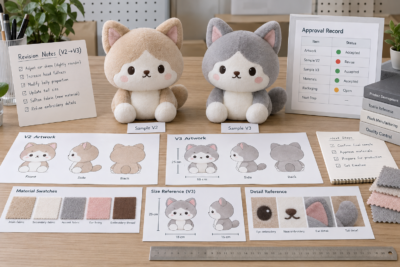
Take the prior revision list and close each comment deliberately.
For every item, assign one status:
- Accepted — the current sample meets the agreed direction.
- Revise — a change is still required.
- Open — a decision is pending and has not been approved.
- Not applicable — the item was removed from scope.
This is more reliable than sending a new email containing only the latest three comments while older comments disappear in the message history.
When possible, identify issues by location and reference image.
Weak:
“Face still looks wrong.”
Stronger:
“Raise the left and right eye placement together; keep the current eye size. See marked photo A3.”
Weak:
“Tail is too big.”
Stronger:
“Reduce tail length while keeping the current attachment position; compare with the back-view artwork.”
The goal is not to write longer comments. It is to remove ambiguity.
10. Lock the Version You Are Approving
The final approval should point to a specific reference.
A practical record can include:
- Sample version or ID.
- Date reviewed.
- Artwork/specification version.
- Material or color reference.
- Photo set or file folder used in the review.
- List of accepted revision items.
- List of open items.
- Name or role of the authorized approver.
- Clear release status.
Avoid a message such as “approved, thanks” when several versions are circulating.
A better approval statement is specific:
“Sample V3 is approved as the visual and construction reference for the plush body based on the attached artwork/specification set dated [date]. Packaging remains open and is not included in this approval.”
The wording should match the real project. The key idea is to define both what the approval includes and what it does not include.
Use a Release / Revise / Hold Decision
At the end of the review, choose one of three outcomes.
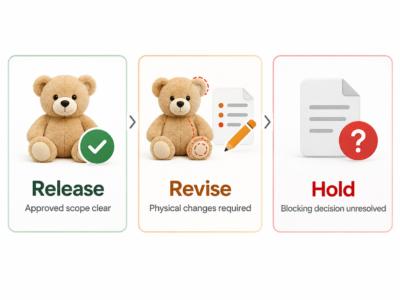
Release
Use Release when the sample and documentation are sufficiently aligned for the next production stage and no unresolved item changes the approved product scope.
Typical conditions:
- Identity-critical details are accepted.
- Overall shape and proportions are accepted.
- Agreed dimensions have been reviewed.
- Material and decoration direction is accepted.
- Construction and visible finish are accepted.
- Included labels/packaging are accepted or clearly excluded from this release.
- Previous revision comments are closed or documented as non-blocking.
- The approved version is clearly identified.
Revise
Use Revise when the direction is correct but specific physical changes are still required before approval.
Examples:
- Facial placement needs adjustment.
- Body volume needs correction.
- An embroidery element is misplaced.
- A material or color reference is wrong.
- An accessory shape or position needs revision.
- Packaging fit fails and packaging is part of the approval scope.
A Revise decision should produce a consolidated change list for the next sample version.
Hold
Use Hold when the team cannot responsibly approve the sample because the reference itself is unclear or a blocking project decision is unresolved.
Examples:
- Different stakeholders are using conflicting artwork versions.
- A major size requirement has not been decided.
- Rights or authorization for branded/IP assets are unresolved.
- The target market or age context changes the technical review and is still unknown.
- A required label, component, or packaging constraint is missing from the brief.
- The team is trying to approve from photos when physical feel or fit is a critical part of the decision.
Hold does not mean the supplier failed. It means the project is not ready for a clean release decision.
Custom Plush Sample Approval Record Template
A simple approval table can keep the decision traceable:
| Review Area | Reference | Status | Comment |
|---|---|---|---|
| Overall shape | Artwork front/side/back | Accepted | Current silhouette approved |
| Face | Marked artwork sheet | Revise | Raise both eyes; keep current size |
| Fabric | Swatch B | Accepted | Use current short-pile material direction |
| Stuffing | Physical Sample V3 | Accepted | Current seated posture approved |
| Label | Label file v2 | Open | Legal copy still under buyer review |
| Packaging | Box dieline | Not in scope | Separate packaging approval required |
After revisions are complete, update the record rather than creating a second, disconnected list.
What Should Not Be Approved From Photos Alone?
Photos are useful for remote communication, but they have limits.
If the characteristic affects touch, physical scale, three-dimensional volume, or material behavior, a buyer may need the physical sample or an agreed physical reference.
Examples include:
- Hand feel.
- Stuffing firmness.
- Actual scale.
- Side-profile volume.
- Fabric pile and sheen.
- How a removable garment fits.
- How an accessory changes balance.
- How the plush fits a box, insert, or display if physical fit is critical.
- Subtle color judgments where screen display is not an adequate reference.
Photos can support approval by documenting angles, details, and revision locations. They should not automatically replace physical review for characteristics that a photograph cannot reliably convey.
Sample Approval Is Not the Same as Compliance, Bulk QC, or Commercial Approval
A strong approval process keeps different decisions separate.
Sample approval answers:
“Is this defined physical product version acceptable as the reference for the next stage?”
Compliance and testing answer:
“What requirements apply to this product and market, and has the required evaluation or documentation been completed?”
Bulk quality control answers:
“Does production remain within the agreed project specifications and quality plan?”
Commercial approval answers:
“Are price, quantity, payment, delivery, and other order terms agreed?”
包装审批可能是样品审批的一部分,也可能是一个单独的工作流程,具体取决于项目。
将这些决策分开处理,可以简化项目管理。同时,也能避免模糊的“已批准”信息被误解为对未经审核事项的批准。
常见样品审批错误
因为样品“可爱”所以批准。
一个成功的毛绒玩具样品必须满足预期的角色、产品和项目要求——而不仅仅是给人留下良好的第一印象。
仅查看正面
侧面和背面的视图可以显示厚度、姿势、尾巴位置、服装合身度、颜色拼接和接缝问题,这些问题从正面是看不到的。
将设计变更与修正相结合
修正使样本向已确定的目标值靠拢。设计变更则改变目标值本身。将两者分开,以便保持修订历史的清晰易懂。
在关闭旧评论之前添加新评论
未解决的问题要一并处理,不要因为新样品到货就让它们消失。
在作用域之前使用“final”是最终的
如果包装、标签、配件或其他包含的元素仍有待审批,请说明哪些已获批准,哪些仍在审批中。
将样品视为批量一致性的证明
良好的样品仅供参考,并不能保证所有批量生产的产品都与之完全一致。批量生产仍然需要自身的生产控制和检验方案。
常见问题解答
每个定制毛绒玩具项目都需要实物样品审批吗?
合适的样品制作方式取决于具体项目,但当形状、手感、填充物、材料纹理、三维比例、配件装备性或包装性至关重要时,效果样品就严重视野重要。如果进行团队远程指导,则应明确哪些特性是通过外观审核的,哪些特性仅通过图片或文件审核的。
什么是“黄金样本”?
一些制造团队使用“黄金样品”作为经批准的样品参考,用于生产或质量比较。术语因工厂或项目而异,工作站想当然认为该术语在每个工厂或项目中暗示相同。必须明确保留所用样品版本、其代表的规格,以及后续哪些变更需要新的参考样品。
包装还没拆封,我们可以批准这件毛绒玩具吗?
是的,如果包装确实超出当前巧克力范围,并且该范围有相关文件记录。如果包装以某种方式影响毛绒玩具的尺寸、压缩性、配件位置、标签位置或外观,从而可能需要对产品进行更改,则应在相关产品发布前解决这些依赖关系。
请求是否应在火箭进程中设定通用尺寸公差?
不宜为所有毛绒玩具设计制定通用的公差标准。测量要求应根据具体项目而定,并根据商定的尺寸、结构、材料特性、包装需求和质量计划。记录关键测量点和复核方法。
谁应该最终批准样品?
对于简单的项目,可能只需一名产品负责人。对于授权或零售项目,则可能需要设计、销售、许可、质量、合规或包装等相关人员的参与。关键在于明确谁有权发布相关范围,避免不同人员之间出现冲突。
曼哈顿之后,我们应该向供应商发送什么信息?
发送一份清晰的批准信息,其中包括样品版本、当前图稿/规格集、已关闭的修订意见以及任何剩余的未完成事项。确保成品参考资料和支持文件清晰可辨,以便后续的生产讨论能够同样已批准版本。
最终建议:批准版本,感觉
最好的解剖样本应该足够具体,以便其他人以后重建电子邮件链能够理解该决定。
在批量生产开始之前,请确保您的团队能够回答以下问题:
- 样品哪个版本获得批准?
- 它符合哪款美术设计和规格?
- 审查了哪些视觉、材料、结构、标签和包装细节?
- 还有未售出的商品吗?
- 大家都明白这次批准主题有哪些内容,不主题有哪些内容?
如果这些问题的答案很明确,那么这个样品就成为了一个有用的参考项目,而不仅仅是一个每个人记忆都不同的原型。
如果您正在准备定制毛绒玩具项目,并希望发送设计稿、样品说明或要求项目供审核,请联系MSXTOYS: