
How Custom Plush Toys Are Made: From Artwork to Bulk Production

How Custom Plush Toys Are Made: From Artwork to Bulk Production
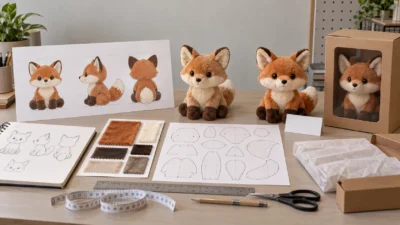
Custom plush manufacturing is not simply a matter of sewing a character from a drawing. A buyer’s idea must become a workable pattern, a physical prototype, an approved specification and, finally, finished units that can be checked against the same reference. Decisions about fabric, facial details, accessories, packaging and destination market influence that journey long before bulk production starts.
This plush toy manufacturing process guide follows one original design across the information handoffs a B2B buyer can ask to see: artwork and feasibility, pattern development, sampling, approved references, production instructions, making and inspection, then packing and dispatch. It explains common methods and buyer-side decisions; the equipment, sites, production responsibilities and commercial terms for an actual MSXTOYS project are agreed for that order.
MSXTOYS is a custom plush toy OEM/ODM manufacturer founded in 2005. If you are deciding what information to send first, start with our custom plush RFQ preparation guide. This page addresses the next question: how does that brief become a product ready for repeatable production?
Custom plush manufacturing process: stages, handoffs and approvals
A typical project has four distinct planning decisions: feasibility defines what will be developed; sample approval names the accepted design reference; bulk release specifies how that reference becomes an order; and inspection and shipment readiness verify the agreed completion conditions. Projects may coordinate these decisions differently, so treat this table as a buyer’s planning map rather than a promise of one fixed factory sequence or timetable.
| Stage | Manufacturing question | Buyer-visible output |
|---|---|---|
| Brief and feasibility | What are we making, for whom and with which constraints? | Project brief and a list of open decisions |
| Artwork and construction | How will flat artwork become a soft, sewable shape? | Artwork references, pattern direction and material options |
| Prototype and revision | Does the physical interpretation express the intended character? | Identified sample version and specific review notes |
| Approval and bulk handoff | Which version, components and tolerances are agreed? | Approved reference plus controlled production information |
| Manufacturing and checks | How will the same specification be repeated and evaluated? | Units, inspection criteria and product-specific documentation plan |
| Packing and shipment | What must be packed, labelled and handed over? | Packout requirements, quantity reconciliation and dispatch conditions |
What this page covers—and what it does not
The process page is the map of how a product moves between decisions. It is not a substitute for a full RFQ preparation guide, detailed sample approval checklist, a binding quotation, or a product-specific compliance assessment. Each is a separate buyer decision. Manufacturing steps described here are typical options: the product, confirmed facility, suppliers, required controls and approved schedule determine the actual route.
For the buyer, the central question is not simply “has the factory reached the next stage?” It is “which product reference and open decisions were handed to the next person?”
1. Define the product before discussing production
Begin with the use case, not only the artwork. A licensed character intended for a retail shelf, a plush keychain for a campaign and a large display mascot can share visual assets while requiring different structures, attachments, labels and packing decisions. A quote for one cannot safely be assumed to cover the others.
A first brief should identify the product type; intended audience and sales market; approximate finished size and how it is measured; expected quantity per design or SKU; artwork or physical references; essential materials or hand feel; branding and packaging direction; and the desired arrival window. Mark every major item confirmed, flexible or undecided. A buyer who is still exploring fabric choices can state the desired result without inventing a material code.
Decision gate — feasibility: before authorizing development, ask which design features are straightforward, which need a physical trial, which facts the quotation assumes and which requirements could change the intended construction. Record who owns the character artwork or has permission to use it; do not send protected third-party designs on the assumption that manufacturing rights are automatic.
Who should confirm what at the feasibility handoff?
At this stage the buyer owns the business brief and any necessary artwork authorization. The manufacturer or supplier should explain its proposed construction and the assumptions behind feasibility; the parties should identify who is responsible for development, sourcing, any specialist work, compliance planning and sign-off. An idea that is technically possible is not yet a promise about a fixed unit price, minimum order quantity or delivery date.
A helpful feasibility note is short: “Proposed seated plush; rear-view artwork outstanding; face must remain embroidered; fabric hand feel flexible; retail packaging required; quantity split to confirm.” The specifics are illustrative, not an MSXTOYS project record.
2. Turn two-dimensional artwork into a sewable plush design
A front drawing usually communicates the character’s expression, but it may not specify the back of a costume, the depth of the head, the tail angle, the underside of a foot or the way a plush should balance while sitting. A photograph may be equally useful as a concept yet less useful as a dimensioned specification. Front, side and back references help expose these missing decisions.
Plush construction translates curved volume into fabric panels joined at seams. Pattern placement affects how the toy turns, stretches and holds its silhouette once filled. The manufacturer needs to distinguish features that must be preserved—perhaps the eye spacing or outline of the ears—from details that can be simplified for a small or soft construction.
For example, a fine printed mouth on a large drawing may lose definition on long-pile fabric. Moving it to embroidery, changing the surrounding fabric or simplifying the line can be considered during sampling. That is a design trade-off to approve, not a change a production team should silently make later. Pattern shape, face placement and material choice need to be reviewed together because a correction to one may alter the others.
Pattern handoff: preserve intent without pretending a sketch is a cutting file
For a hypothetical seated character, the buyer’s front drawing might preserve a rounded cheek and visible smile, while the side view reveals that the head must be deeper than the illustration suggests. A pattern trial tests both together. The buyer can approve the recognizable expression and silhouette; the development team determines how to construct the volume and must flag any changes that visibly alter the design.
A useful pattern-stage handoff identifies the reference drawing version, finished-size direction, pose, features that cannot change, and which decisions are provisional until the sample is handled. The future production team should not have to reconstruct the design intent from an email conversation.
3. Choose materials and decoration for the intended result
Fabric selection affects more than softness. Pile length changes how light reflects from the surface and whether small embroidered details remain legible. Stretch can change the dimensions of sewn panels. Pile direction can make two pieces of the same fabric appear different when placed in opposite orientations. Filling amount and distribution affect posture, thickness and the face after assembly.
Compare physical swatches where feel or colour matters. Confirm whether the product uses embroidery, printing, appliqué, woven or sewn-in labels, clothing, hangtags, a keyring or other attachments. Do not assume that an accessory shown in a drawing can be attached at any size without a separate construction and intended-use review.
A useful sample-stage record identifies the approved fabric reference, colour reference, decoration artwork and important component positions. A phrase such as “soft pink fabric” may help start the conversation, but it is not a reliable bulk material reference by itself. The objective is a specification another person can use without guessing which swatch or file the buyer meant.
Control the difference between a material suggestion and a substitution
A suggested fabric during early development is a design option. Once a particular fabric and colour reference have been approved, replacing it with another textile can change pile, stretch, apparent shade, embroidery visibility, shape and possibly the product-specific evaluation plan. Ask which material details are fixed and who must approve alternatives if sourcing changes later. A matching colour name alone is not an equivalent-material decision.
4. Make the first physical prototype answer specific questions
The first prototype tests whether the proposed pattern and materials create the intended three-dimensional product. It can expose a head that is too shallow from the side, a tail that changes the sitting pose, a seam that pulls a smile out of alignment or a fabric whose texture masks a logo. These issues are easier to describe when the reviewer compares the same views used in the artwork brief.
Review the actual physical sample when practical; photos are useful for documenting changes but do not communicate touch, firmness or scale perfectly. Compare the overall silhouette from front, side and back, then inspect the face, dimensions at named measurement points, fabric, embroidery or print placement, visible seams, stuffing distribution, clothing and accessories. If packaging has already been developed, check the product in its intended pack as well.
Record the version and observations rather than sending only “please make it cuter.” For example: “Sample V2: reduce the side-view head depth while retaining the approved eye size; keep the short-pile fabric reference B.” A note like this identifies the element to adjust and the feature that should stay fixed. One change may affect the pattern and face position, so evaluate the revised sample as a whole.
Use revision notes that connect cause to the next sample
Good revision instructions identify the affected view, the observed problem, the requested change and the features that should remain untouched. For example, “Side view: add depth to the back of the head while keeping front-view eye spacing and embroidery size.” At the next review, inspect both views again; a change that fixes the side profile can move the face or alter the sitting balance.
The detailed pass/fail points belong in the physical sample approval guide. On this process page, the purpose is to show how an exploratory prototype becomes a controlled reference for the next stage.
5. Approve a defined sample, not a general impression
“Looks good” does not identify a production standard. The decision should specify the exact sample version, the artwork or specification date, the fabric and colour references, and whether accessories, labels and packaging are included. Review earlier change requests one by one. An item that remains open should be named as open, not treated as approved because the rest of the plush is acceptable.
A practical approval record can include sample photographs, the physical reference retained by the agreed parties, finished measurement points, embroidery files, material references, accessory details and a short accepted/revise/open log. A golden sample is useful as a physical comparison reference, but it does not replace the written details that distinguish one colourway or SKU from another.
Decision gate — sample approval: before releasing bulk work, answer: Which version is approved? What is excluded from this approval? Which file set will the production and inspection teams use? For a detailed product-level review, see the custom plush sample approval checklist. The detailed review belongs with that sample-stage decision, while this page follows the handoff into bulk production.
Three different approvals that should not be collapsed into one
| Decision | What it can establish | What it does not establish by itself |
|---|---|---|
| Design / sample approval | A named physical and visual reference for the agreed scope | That every label, test, production variation and shipping term is approved |
| Bulk production release | A controlled specification, quantity split, responsibility map and relevant holds | That every finished unit has passed inspection or shipment can depart |
| Inspection / shipment release | Defined finished-goods, packout and document conditions have been addressed | A substitute for applicable product-specific regulatory compliance |
These decisions may be coordinated differently across real orders. Their value is in making the approval scope visible rather than assuming one friendly email covers every remaining obligation.
6. Translate approval into a production-ready order
A beautiful one-off sample is not a complete bulk instruction. A production handoff needs a controlled set of product and order information: the approved sample and artwork version; dimensions and measurement method; fabric and colour references; decoration and accessory files; quantity by SKU; packaging and label files; inspection criteria; and who can authorize changes.
For a project with three colourways, distinguish the common pattern from each colourway’s specific fabric, thread, label, quantity and carton identification. Do not give only a combined order total and expect the production team to infer the allocation. If the customer introduces a new accessory or changes the retail box after sample approval, the affected specification, quote, schedule and any testing plan should be reviewed again rather than silently amended.
| Release item | Question before bulk work | Possible hold condition |
|---|---|---|
| Approved version | Is the same sample and file revision named everywhere? | Factory and buyer reference different samples |
| Materials and components | Are swatches, trims and decoration references identified? | Substitute fabric or accessory has not been approved |
| SKU allocation | Are design, colour, size and quantity assigned per SKU? | Total quantity exists but variant breakdown is missing |
| Quality and market plan | Are the inspection scope and applicable testing responsibilities agreed? | Important label or target-market decision remains unresolved |
| Packaging and handover | Are packout, carton identifiers and delivery scope defined? | Packing format changes after quote or sample sign-off |
Not every open item blocks every operation. A carton artwork change might be managed as a separately controlled packaging workstream if the parties agree on the boundary; an unapproved eye attachment or major pattern change may require a new product sample and affected compliance review. The hold decision should reflect what the unresolved item changes—not a blanket rule applied to every order.
Production handoff example: keep colourways and component versions separate
Consider a hypothetical character plush offered in two colourways. Both use the same approved body shape, but each needs its own fabric shade, matching embroidery thread, SKU identifier, quantity allocation and packaging reference. A combined purchase total does not show which shade should be sewn, packed or counted. A change to the face artwork or sewn label must be assigned to the affected SKU rather than copied to every variant by assumption.
One practical control is a revision register with columns for file or sample identifier, affected SKU, proposed change, buyer decision, date and the records that must be updated. A separate reference list may identify the physical sample retained for comparison. The precise record format depends on the project; the example is not a record from an MSXTOYS customer order.
| Handoff item | Question to ask | If unanswered |
|---|---|---|
| Pattern / sample version | Which revision is the production reference? | Different teams can reproduce different shapes |
| Variant map | Which fabric, embroidery, label and quantity belong to each SKU? | Correct parts can be combined into the wrong variant |
| Change authority | Who can accept an alternative material or design adjustment? | An unapproved substitution may be treated as routine |
| Inspection reference | Which observable characteristics and records will be compared? | Approval may rely on memory instead of an agreed standard |
7. What happens during bulk plush manufacture?
Once product and order details are released, bulk plush manufacturing typically uses a combination of the operations below. Their order, equipment and location depend on the design, the production arrangement and any outsourced specialist steps. The description is an industry process explanation, not a claim that every operation occurs inside one MSXTOYS building.
Before the line starts: align the reference and the work
A buyer can ask whether the released order identifies the approved sample, current pattern and decoration files, material references, SKU matrix and any special requirements before making begins. The actual pre-production meeting, line allocation, subcontracting route and inspection method must be verified against the supplier’s specific project plan; a planning checklist does not replace confirmation of the actual project arrangement.
Material preparation and panel cutting
Confirmed fabric is prepared for the required pieces. Pattern pieces or cutting information define the shape and orientation of panels; alignment matters for pile, stretch, stripes and colour blocks. A reversed pile direction can change the apparent shade of a plush face even if the fabric is technically the same. Ask how the approved references will be available when materials or panels are checked.
Embroidery, printing and construction details
Some surface decoration is applied while panels are flat; other details are attached after partial assembly. The choice depends on placement and construction. A tiny embroidered eye close to a curved seam may look different after the head is filled, so approval should consider the final assembled appearance rather than only the flat decorated panel.
Sewing, turning, filling and closing
Panels are assembled into a soft three-dimensional shell, turned where needed, filled, closed and finished. Seam shape affects the silhouette. Fill distribution changes body thickness, firmness and how the toy sits or hangs. Closing, trimming and final shaping complete the visible presentation. For a character plush, the agreed face position and overall profile are practical control points; expecting every soft unit to be mathematically identical is not a useful production specification.
Special constructions
Clothing, removable or fixed accessories, keyring hardware, sound components or multi-part packs can add operations and checkpoints. Confirm whether these features are included in the approved sample and which party is responsible for sourcing or assembling them. A manufacturing page should describe the applicable route for an actual project rather than claim one fixed line layout for every product type.
Where typical process variation is introduced
Soft construction introduces variability at several points: fabric pile can be oriented differently at cutting; curved seams can change the face after turning; fill distribution can change posture; small accessories can shift during attachment; compression can alter retail presentation. The approved sample provides the intended outcome, while the agreed inspection plan defines how meaningful differences are identified. This is a practical reason to check work across stages rather than comparing only a final product photograph.
8. Keep production inspection separate from product-safety testing
Quality checks ask whether finished products follow the approved reference and agreed workmanship criteria. Depending on the order, relevant observations may cover proportions, named dimensions, embroidery placement, seam appearance, accessory position, filling, labels, packout and carton identification. The specific sampling approach, checkpoints and acceptance criteria should be agreed for the project; they should not be inferred from a generic claim such as “100% inspected.”
Product safety and regulatory compliance answer a different question: whether the actual product meets the requirements that apply to its intended market, age category, materials and construction. Give the supplier the destination country and intended audience early. Confirm which party identifies requirements, arranges any applicable laboratory testing and maintains the necessary reports or certificates. A visual sign-off is not a safety certification; an old report for a different design is not universal proof for a new plush toy.
For U.S. children’s products subject to applicable children’s product safety rules, the U.S. Consumer Product Safety Commission’s CPC guidance describes third-party testing and written certification requirements, including the certifying responsibilities of domestic manufacturers or importers. The applicable rules, exceptions, laboratory and product identity must be reviewed for the actual item. A visual sample approval or an unrelated factory audit is not a Children’s Product Certificate.
Decision gate — inspection and shipment readiness: identify the reference used for production inspection, the relevant product-specific compliance and document responsibilities, and which unresolved issues prevent completion or shipment. If a buyer needs third-party pre-shipment inspection, agree its scope and timing as part of the order—not as an implied standard promise.
9. Pack and hand over the order you actually approved
Packaging belongs in product planning because a plush can change shape when compressed into a small box or bag. Establish whether the order needs individual protection, sewn-in labels, hangtags, barcode or SKU labels, branded retail presentation, inserts or specific carton marks. Verify any requirements that affect the toy’s shape or how accessories sit inside the pack.
Before dispatch, reconcile finished quantities by SKU with packing lists and carton identification. Confirm the delivery destination, agreed shipping terms, inspection conditions and the documents each party is responsible for providing. A buyer’s required in-store or event date is useful planning information, but it should not be mistaken for a supplier-confirmed production or transit guarantee.
What should a brand send to start a custom plush project?
You do not need to solve every technical question before speaking to a manufacturer. Send enough information to distinguish what you know from what needs development:
- Original or authorized character artwork, reference images or a physical reference.
- Product format, intended use and target audience.
- Approximate size, measurement direction and any design features that must remain unchanged.
- Expected quantity by design or SKU, or a realistic range if not yet final.
- Material feel, branding, decoration, clothing and accessory preferences.
- Target sales market and any known retailer or documentation requirements.
- Packaging direction, destination and target arrival window.
- A short list of confirmed, flexible and undecided items.
The earlier RFQ step turns these details into an inquiry. If you are evaluating several suppliers, the manufacturer evaluation guide explains how to compare their evidence and proposed responsibilities.
Discuss the next manufacturing step with MSXTOYS
Have artwork and a product idea, but not yet a complete specification? Send the available files and identify your intended size, approximate quantity, market and packaging needs. MSXTOYS can discuss the proposed custom plush project and the information needed for a feasibility and quotation conversation. The relevant manufacturing route, production-site responsibilities, sampling policy, price, MOQ and dates should be confirmed for your specific order.
Send your artwork and project details to sales@msxtoys.com, or use the inquiry form on the MSXTOYS contact page.
Custom plush manufacturing FAQs
These answers describe planning principles. A quotation and the applicable project documents determine MSXTOYS-specific production scope, fees and dates.
Can a sketch be enough to start the manufacturing conversation?
Yes, a sketch or reference image may be enough for initial feasibility discussion. Extra angles, dimensions, construction notes and colour references become more important before a sample can be approved and repeated.
What is the difference between a prototype and an approved production sample?
A prototype explores the design. An approved reference identifies the version and specifications accepted for a defined scope. A sample that looks right but has open material, attachment or packaging decisions is not automatically a complete bulk release.
Does sample approval also approve testing, packing and shipment?
No. Product appearance, applicable safety compliance, commercial terms, bulk quality checks and packaging can require separate decisions. A written sample approval should say which of those items it covers.
Will a smaller plush made from the same artwork use the same pattern?
Not necessarily. Scaling can change the visibility of embroidery, the size of features, accessory attachment and the way soft panels hold their shape. Treat a materially different size or construction as a distinct specification that needs review.
Can a fixed MOQ, sample fee or production lead time be determined from a picture alone?
A picture may support an initial discussion, but a reliable project-specific commitment depends on the approved product scope, SKU quantities, construction, materials, packaging and relevant testing or delivery requirements. Request a quotation and schedule based on those details rather than relying on a generic number.
Do all manufacturing steps happen in one factory?
Not necessarily. Some plush projects use outside material suppliers or specialist decoration, testing or packaging services. Ask which site and party is responsible for the processes relevant to your order; do not infer one-site production from a generic sequence diagram.
What should change if the buyer alters the design after sample approval?
Identify the affected product reference and SKU, then ask whether the change alters pattern, material, price, timing, inspection, packaging or applicable testing. Record the new approval scope before treating the altered version as the production reference.