
How to Choose a Custom Plush Manufacturer: A Buyer’s Evaluation Framework

How to Choose a Custom Plush Manufacturer: A Buyer’s Evaluation Framework
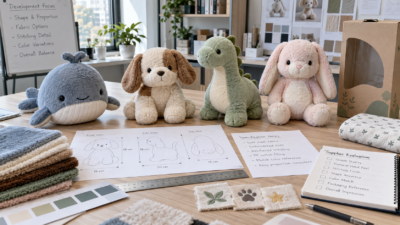
Choosing a custom plush manufacturer is not just a search for the lowest unit price or the most impressive factory profile. A commercial plush project has to move through artwork interpretation, pattern development, sampling, specification control, material decisions, quality checks, packaging, market-specific compliance planning, production, and delivery. A supplier can look strong at one stage and still create problems at another.
A better way to choose is to compare suppliers against the same project brief, the same questions, and the same evidence standard.
For most B2B buyers, the evaluation should answer three questions:
1. Can this supplier develop your specific plush product?
2. Can the supplier transfer an approved sample into repeatable production?
3. Can the supplier show evidence for the capabilities and responsibilities that matter to your project?
This guide explains how to evaluate those questions before you commit to a purchase order.
The Short Answer: What Should You Check?
Before choosing a custom plush manufacturer, review these ten areas:
– project and product fit
– pattern-making and sample development
– specification and revision control
– material and decoration control
– quality-control process
– target-market compliance planning
– production responsibility and capacity evidence
– quotation transparency
– packaging and shipping responsibility
– communication, IP handling, and change control
Do not score a supplier only on what it says it can do. Ask what evidence supports each important claim and how the process would apply to your actual project.
1. Start With Project Fit, Not Factory Size
The first question is not “How big is the factory?” It is “Does this operation fit the product I am trying to make?”
A supplier that is suitable for a simple promotional plush may not be the best fit for a complex licensed character with removable accessories, detailed embroidery, multiple fabrics, retail packaging, and market-specific documentation.
Start by defining your own project:
– product type
– artwork complexity
– target size
– expected quantity or quantity range
– number of SKU
– target market
– intended age group
– packaging format
– launch window
– critical visual or functional details
Then ask the supplier to explain which parts of the project are routine, which parts need development work, and which parts may create risk.
A useful supplier will not simply say “yes” to everything. It should be able to identify trade-offs. For example, a very small embroidered facial detail may need to be simplified, a long-pile fabric may obscure fine stitching, or a rigid accessory may change construction and testing considerations.
That ability to identify constraints early is often more valuable than a broad product catalogue.
2. Evaluate Pattern-Making and Sample Development
For custom plush, the sample process is where a two-dimensional concept becomes a three-dimensional sewn object. This makes development capability one of the most important parts of supplier selection.
Ask how the supplier moves from artwork to pattern and prototype. Useful questions include:
– Who interprets the artwork?
>- Who creates or adjusts the pattern?
>- How are proportions reviewed?
>- How are fabric stretch and pile direction considered?
>- How are facial features positioned?
>- How are accessories attached?
>- How are sample revisions recorded?
>- What information becomes part of the production specification after approval?
Pay attention to the supplier’s questions. A development team that asks about size, viewing angle, expression, intended use, materials, packaging, and target market is showing that it is trying to define the product rather than merely produce a quick sample.
The quality of the first sample matters, but the revision process matters just as much. A strong development process should make it clear what changed between versions and what is considered approved.
3. Check How the Approved Sample Becomes a Production Specification
A common sourcing mistake is treating the physical sample as the only reference.
A sample is useful because it shows the product in three dimensions, but bulk production also needs controlled information. Buyers should ask what written or visual specification supports the approved reference.
Depending on the project, that may include:
– finished dimensions and measurement points
– fabric references
– color references
– embroidery artwork
– print files
– stuffing or firmness direction
– label placement
– accessory construction
– seam or attachment details
– packaging requirements
– approved revision notes
The goal is not to create paperwork for its own sake. The goal is to reduce ambiguity when the project moves from a sample room into repeated production.
Ask the supplier a simple question: “If the person who made my sample is not standing beside the production line, what information tells the production team exactly what was approved?”
The answer reveals a lot about specification discipline.
4. Review Material and Decoration Control
Custom plush quality depends on more than choosing a fabric that looks similar in a photo.
Materials can change how a character looks and behaves. Pile length can affect embroidery visibility. Stretch can alter proportions. Fabric direction can change shading. Stuffing density can change facial expression. Different backing structures can affect how material behaves during sewing.
During supplier evaluation, ask how materials are selected, confirmed, and controlled.
Useful evidence may include:
– physical swatches
– supplier material codes
– color references
– approved embroidery samples
– printed strike-offs where relevant
– label or trim samples
– records linking approved materials to the production specification
If a material has to meet a particular project requirement, ask how that requirement is communicated through purchasing, incoming inspection, and production.
Avoid accepting vague statements such as “we use high-quality fabric” as proof. “High quality” is not a specification.
5. Look at Quality Control as a System, Not a Slogan
Every supplier can say it has quality control. The useful question is how quality is controlled at different points in the project.
Ask the manufacturer to explain its quality process in practical terms:
– What is checked when materials arrive?
>- What is checked during cutting, sewing, embroidery, stuffing, and assembly?
>- Which defects are most important for this product?
>- How is the approved reference used during production?
>- How are nonconforming pieces identified and handled?
>- What is checked before packing?
>- What inspection information can be shared with the buyer?
For custom plush, quality is often visual as well as dimensional. Eye position, embroidery alignment, ear angle, stuffing distribution, seam shape, accessory placement, and overall silhouette can influence whether a finished piece still looks like the approved design.
The supplier should be able to explain how it converts those visual expectations into repeatable checks.
Do not ask only, “Do you inspect the products?” Ask, “What exactly would you inspect on this design?”
6. Test the Supplier’s Compliance Planning
Compliance should be considered at the start of supplier selection, not introduced after a sample has already been approved.
Tell the supplier where the product will be sold, the intended age group, the sales channel, and any retailer-specific requirements you already know. Then ask how the supplier would determine which testing, documentation, labeling, and material requirements need to be addressed.
A reliable answer should be project-specific. It should not imply that one certificate or one previous test makes every future plush product compliant.
For U.S. children’s products, the U.S. Consumer Product Safety Commission explains that applicable children’s products generally require third-party testing by a CPSC-accepted laboratory, with certification responsibilities tied to the responsible manufacturer or importer and the rules that apply to the specific product. The exact requirements depend on factors such as product type, intended age, use, and materials.
That is why buyers should ask a supplier to explain the compliance path for the actual product, not simply show a folder of unrelated certificates.
Important questions include:
– Which target market is being evaluated?
>- What product and age assumptions are being used?
>- Which party coordinates testing?
>- Which laboratory will be used, if testing is required?
>- How are material or construction changes handled after testing?
>- Who is responsible for required documentation?
>- Can reports be matched to the relevant product, material, factory, and date?
7. Verify Production Responsibility and Capacity With Evidence
Large capacity claims can sound reassuring, but a number by itself does not tell you whether your order can be produced reliably.
Instead of asking only for monthly capacity, ask how your project would actually be produced.
Useful questions include:
– Which facility would produce the order?
>- Which major processes are performed there?
>- Which processes, if any, are subcontracted?
>- Who approves subcontracting?
>- How is production scheduled?
>- What other constraints affect the requested window?
>- How does the supplier plan around multiple SKUs?
>- How will packaging or testing affect the schedule?
If capacity is important, ask for evidence connected to the actual production site and order plan. This could include a current production schedule, line allocation explanation, recent non-confidential production examples, or a live video review of relevant operations.
Do not assume that a factory is automatically better than a trading company, or that a trading company is automatically worse. What matters is whether you know who is responsible for development, purchasing, production, quality, documentation, and corrective action—and whether those responsibilities can be verified.
The business model should be transparent enough for you to understand where your product is actually made and who controls each critical step.
8. Normalize Quotations Before Comparing Price
Two quotations can show different prices because they are based on different assumptions.
Before comparing suppliers, normalize the scope.
Check whether each quotation is based on the same:
– product dimensions
– quantity and SKU split
– fabric or material assumptions
– embroidery or printing
– accessories
– labels
– packaging
– testing scope
– shipping term
– delivery destination
– sample or development scope
If one supplier includes a retail box and another assumes simple packing, the unit prices are not directly comparable. The same problem occurs when suppliers use different materials, different size measurements, different quantities per SKU, or different commercial terms.
A good quotation should make its assumptions visible.
If a price looks unusually low, do not immediately treat it as a warning or a bargain. First ask what is included, what is excluded, and which assumptions differ from the other quotations.
9. Check Packaging and Shipping Responsibility
Packaging can affect cost, product protection, retail readiness, carton volume, labeling, and the final delivery schedule.
Ask the supplier what it expects from you and what it will handle.
Depending on the project, confirm:
– individual packaging
– hangtags
– sewn or woven labels
– barcode labels
– warning or care labels
– retail boxes or inserts
– carton marks
– master carton configuration
– e-commerce preparation
– export packing
– shipping documentation
– delivery term and destination
Packaging should not be treated as an afterthought if it is important to the sales channel.
For a retail program, packaging development may need to move alongside product development. For a promotional project, simple packing may be enough. The supplier should understand the difference before the quotation is finalized.
10. Evaluate Communication, IP Handling, and Change Control
Good communication is not just fast messaging. It is the ability to turn decisions into controlled project information.
During sampling, watch how the supplier handles changes.
A useful communication process should answer:
– Who is the main project contact?
>- How are revisions documented?
>- How are contradictory instructions resolved?
>- What requires written approval?
>- How are files versioned?
>- How are material substitutions communicated?
>- How are changes after sample approval handled?
>- How are confidential or unreleased designs shared and stored?
If the project involves licensed or confidential assets, clarify your requirements before sending sensitive files. Confirm who can access the files, whether an NDA is needed, and whether subcontractors or outside service providers may receive project information.
The important signal is not whether a supplier says “we protect IP.” It is whether it can explain the actual handling process.
Use an Evidence Ladder Instead of a Yes/No Checklist
Supplier evaluation becomes more reliable when you separate claims from evidence.
Level 1: Statement
The supplier says it can do something. Example: “We have strong quality control.”
Level 2: Process Explanation
The supplier explains how it does it. Example: “We check incoming materials, monitor critical sewing and embroidery points, compare production against the approved reference, and perform a pre-packing inspection.”
Level 3: Supporting Evidence
The supplier shows current, relevant evidence. Examples include a non-confidential inspection record, material approval sheet, current facility document, sample revision record, or live process walkthrough.
Level 4: Project-Specific Application
The supplier explains how the process will apply to your product. Example: “For this mascot, we would control eye spacing, embroidery position, ear angle, finished height, stuffing distribution, label placement, and packaging against the approved specification.”
The higher levels are more useful because they connect capability to your actual sourcing decision.
A Three-Stage Supplier Selection Process
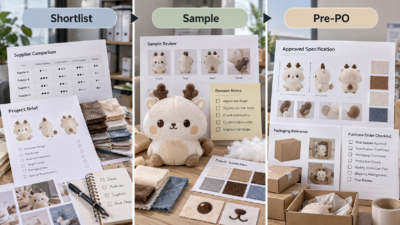
Do not try to make the final decision from a website and quotation alone.
Stage 1: Shortlist
Goal: remove obvious mismatches.
Compare:
– product fit
– basic development capability
– target-market awareness
– communication quality
– business transparency
– rough commercial fit
At this stage, ask for enough evidence to decide whether further development work is worth the time.
Stage 2: Sample
Goal: test how the supplier works, not only what the sample looks like.
Evaluate:
– interpretation of artwork
– questions asked before development
– handling of technical trade-offs
– revision discipline
– material communication
– consistency of measurements and details
– response to corrections
– clarity of the approval process
A beautiful sample is positive, but a supplier that reaches it through uncontrolled trial and error may still create risk in bulk production.
Stage 3: Pre-PO Verification
Goal: confirm that the approved product can move into a controlled order.
Before the purchase order, align:
– approved product specification
– quantity and SKU split
– packaging
– testing and documentation responsibilities
– production site
– inspection plan
– commercial terms
– shipping terms
– delivery requirements
– change-control process
This is where assumptions should become written commitments.
Supplier Comparison Scorecard
A scorecard helps prevent one attractive factor—usually price or sample appearance—from dominating the decision. You can create your own weighting, but a useful structure is:
Development Capability
Question: Can the supplier translate the design into a manufacturable plush product? Evidence: sample process, pattern discussion, and relevant non-confidential examples.
Specification Control
Question: Can approved details be documented and transferred to production? Evidence: specification sheets, revision records, and measurement control.
Material Control
Question: Are materials and decorations clearly identified and approved? Evidence: swatches, codes, and approval records.
Quality Control
Question: Can the supplier explain product-specific checks? Evidence: inspection examples, defect criteria, and production checkpoints.
Compliance Planning
Question: Does the supplier understand how target market, age, materials, and construction affect the compliance path? Evidence: a project-specific explanation and relevant current documentation.
Production Transparency
Question: Do you know where and how the order will be produced? Evidence: facility information, process map, production plan, and approved subcontracting route.
Commercial Clarity
Question: Can quotations be compared on the same scope? Evidence: clear assumptions, inclusions, exclusions, and order terms.
Packaging and Delivery
Question: Are retail, carton, export, and delivery responsibilities defined? Evidence: packaging specification and shipping scope.
Communication and Change Control
Question: Are decisions documented and changes controlled? Evidence: revision history, approval process, and named responsibility.
IP and Confidentiality
Question: Are sensitive assets handled according to your requirements? Evidence: NDA process, access controls, and file-sharing practice.
The score itself is less important than forcing every supplier to be judged by the same standard.
Red Flags to Investigate Further
A red flag should trigger a question, not an automatic conclusion.
Investigate further when a supplier:
– quotes before understanding basic product specifications
– says every difficult detail is “no problem” without discussing trade-offs
– cannot explain where the order will be produced
– gives inconsistent answers about who controls sampling or production
– cannot connect a certificate or report to a relevant entity, site, product, or date
– avoids documenting sample revisions
– changes materials without clear approval
– provides a very low price but cannot explain the underlying specification
– treats compliance as a generic badge rather than a product-specific process
– refuses reasonable requests for non-confidential evidence
– promises an aggressive schedule without asking about sample approval, packaging, testing, quantity, or shipping
– relies on customer logos or famous brand names instead of showing process evidence
None of these points proves that a supplier is unsuitable. They are reasons to ask for clarification before increasing your commitment.
12 Questions to Ask a Custom Plush Manufacturer
1. What information do you need before you can evaluate this design properly?
2. Who creates and revises the plush pattern?
3. How do you record sample changes and final approvals?
4. What becomes the production specification after the sample is approved?
5. How are fabrics, colors, embroidery, labels, and accessories controlled?
6. What would your QC team check specifically on this design?
7. How would you plan compliance for our target market and intended age group?
8. Which facility would produce this order, and which processes happen there?
9. Are any processes subcontracted, and how are they controlled?
10. What assumptions are included in your quotation?
11. How are changes after sample approval handled?
12. What evidence can you provide for the capabilities that are most important to this project?
Ask the same core questions to every shortlisted supplier. Otherwise, you are comparing different sales conversations instead of different manufacturing options.
Frequently Asked Questions
Should I always choose a factory instead of a trading company?
Not automatically. A direct factory may offer clearer production visibility in some situations, while a capable sourcing or trading organization may add useful project management in others. The important issue is transparency: you should know where the product is made, who controls development and quality, and who is accountable when something changes.
Is the lowest quote usually a bad sign?
No. A low price is not evidence of poor quality by itself. The right response is to normalize the quotations. Check size, material, quantity, SKU split, decoration, packaging, testing scope, commercial terms, and delivery assumptions before comparing prices.
How important is the first plush sample?
Very important, but it should not be judged only on appearance. Evaluate how the supplier interpreted the artwork, communicated constraints, recorded revisions, confirmed materials, and translated the approved result into a production specification.
What factory certificates should I ask for?
Ask for documents that are actually relevant to your supplier due diligence, target market, retailer requirements, and product. Verify the entity, facility, scope, issuer, date, and current status instead of relying on certificate names in a sales presentation. Product compliance and factory social or management-system audits are different types of evidence and should not be treated as interchangeable.
How can I check whether a supplier’s capacity claim is realistic?
Ask how your specific order fits into the production plan. Confirm the production site, processes, SKU structure, requested window, packaging, testing, and any subcontracting. A project-level capacity explanation is more useful than a large monthly number without context.
When should I place the purchase order?
Only after the key product, quantity, packaging, commercial, compliance, production, inspection, and delivery assumptions are sufficiently clear for your organization. The level of detail depends on the project, but the purchase order should not be the first time critical responsibilities are defined.
Final Decision: Choose the Process You Can Verify
A reliable custom plush manufacturing partner is not simply the supplier with the best-looking website, the biggest capacity claim, the fastest promise, or the lowest quotation.
Choose the supplier that can show how your product will move from artwork to approved sample, from approved sample to controlled production, and from production to the required packaging and delivery scope.
The most useful comparison is simple:
– use the same project brief
– ask the same core questions
– request evidence for important claims
– test the supplier through sampling
– normalize quotation assumptions
– confirm responsibilities before the purchase order
If you are currently comparing manufacturers, you can send your artwork and project details to MSXTOYS for a feasibility discussion. Treat the response the same way you would evaluate any shortlisted supplier: check the questions asked, the assumptions made, and the evidence provided before you decide how to proceed.
One thought on “How to Choose a Custom Plush Manufacturer: A Buyer’s Evaluation Framework”